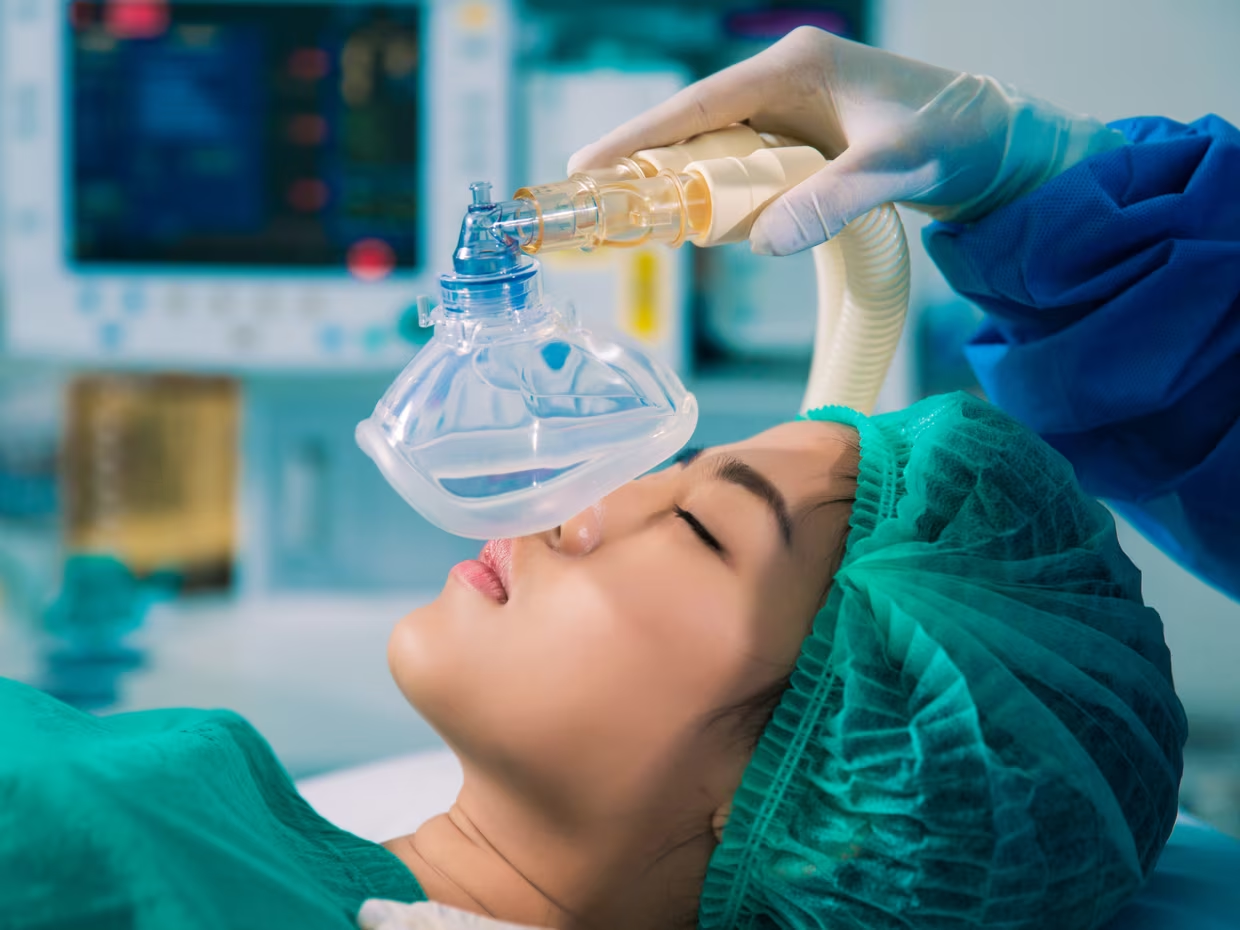
When patients ask us how safe their plastic surgery will be, we always begin with the same answer : "It depends as much on your anesthesiologist as on your surgeon."
Modern anesthesia is one of the great quiet revolutions of medicine — and in plastic surgery, where the operations are elective, the patients are healthy and the goals are aesthetic, the standard of anesthesia care has to be impeccable. In this article, the Argaman Plastic Surgeries Mexico team explains the four types of anesthesia used in plastic surgery, when each one is appropriate, what happens in the operating room from a strictly anesthetic perspective, and why our protocol always requires a dedicated, board-certified anesthesiologist for every single procedure.
Why anesthesia matters as much as the surgery itself
A surgeon operates on the outside of the body. The anesthesiologist operates on the inside — on consciousness, on breathing, on blood pressure, on the inflammatory and pain response, and on every drug interaction that may occur during the four to six hours you are asleep.
A perfect surgery with imperfect anesthesia is not a good surgery. That is why, at every accredited centre in the world, the anesthesiologist is considered the silent guardian of the operating room.
The four types of anesthesia used in plastic surgery
Modern plastic surgery uses four families of anesthetic technique, alone or in combination, depending on the procedure :
- General anesthesia : full unconsciousness with controlled breathing, used for any procedure longer than one hour or involving multiple body areas.
- Sedation (Monitored Anesthesia Care, MAC) : a deep relaxed state combined with local anesthesia at the surgical site, used for shorter or less invasive interventions.
- Regional anesthesia : peripheral nerve blocks or epidurals to numb an entire region of the body, sometimes used for arm or thigh procedures.
- Local anesthesia alone : the surgical site only, used exclusively for minor procedures such as small lesion excisions or injectables.
General anesthesia, in detail
General anesthesia is the technique used for almost every abdominoplasty, breast augmentation, large-volume liposuction, face lift, mommy makeover and BBL. It combines three intentional effects : unconsciousness, complete pain blockage and controlled breathing.
In practice, the anesthesiologist :
- Induces sleep with a short-acting intravenous medication, usually propofol.
- Inserts an endotracheal tube or laryngeal mask to secure the airway and maintain controlled ventilation.
- Maintains the depth of anesthesia with a precisely-titrated mixture of inhaled and intravenous agents.
- Manages your blood pressure, heart rate and fluid balance continuously throughout the procedure.
- Wakes you up gradually in the operating room or recovery area at the end of surgery, removing the airway support before you regain awareness.
Sedation (MAC) and when it is appropriate
Monitored Anesthesia Care — sedation — preserves your own spontaneous breathing while placing you in a deeply relaxed state. It is combined with local anesthesia at the surgical site so that no pain is felt despite the lighter level of consciousness.
Sedation is appropriate for :
- Upper or lower blepharoplasty (eyelid surgery).
- Lip lift, buccal fat removal, otoplasty.
- Small fat transfers (for example, to the face).
- Some forehead or temporal endoscopic procedures.
It is not appropriate for procedures that last more than 90 minutes, for surgeries that compress the chest or abdomen, or for any operation where airway control is needed for safety reasons.
Local and regional anesthesia
Local anesthesia is what your dentist uses : a single injection of lidocaine or articaine numbs a small area of skin and soft tissue. In plastic surgery, it is used alone only for very minor interventions — small scar revisions, mole excisions or injectable treatments such as Botox or fillers.
Regional anesthesia — nerve blocks, epidurals, spinal anesthesia — numbs an entire anatomical region. It is occasionally combined with sedation for arm-lift or thigh-lift procedures, and is administered exclusively by the anesthesiologist.
Why the anesthesiologist matters more than the technique
Patients often ask which technique is "the safest." The honest answer is : the technique matters less than the person administering it. A board-certified anesthesiologist using general anesthesia will keep you safer than an unsupervised nurse delivering sedation.
"Anesthesia is not a syringe — it is a continuous medical act. It needs a doctor, not a delegated technique." — a principle we will not compromise on at Argaman Plastic Surgeries Mexico
At Argaman Plastic Surgeries Mexico, every operating room has its own dedicated, board-certified anesthesiologist — never a nurse anesthetist, never an anesthesiologist running two rooms at the same time. The anesthesiologist stays with you from induction to recovery.
The pre-operative evaluation: ASA classification
Before any procedure, you complete a pre-operative work-up that always includes :
- Complete blood count, electrolytes and coagulation panel.
- Chest X-ray (for patients over 40 or with respiratory history).
- Electrocardiogram (for patients over 40 or with cardiac history).
- Additional cardiac, pulmonary or endocrine evaluation as indicated.
On the basis of these results and a personal medical interview, the anesthesiologist assigns an ASA classification — the international standard for anesthesia risk, ranging from ASA I (healthy patient) to ASA V (moribund). At Argaman Plastic Surgeries Mexico, we operate freely on ASA I and II patients, with internal-medicine clearance on ASA III patients, and we do not perform elective aesthetic surgery on ASA IV or higher.
Intraoperative monitoring: what we watch every second
Throughout your surgery, the anesthesiologist continuously monitors :
- Heart rate and rhythm (electrocardiogram).
- Arterial blood pressure (non-invasive cuff every 3 minutes, sometimes invasive).
- Oxygen saturation (pulse oximetry).
- End-tidal CO2 (capnography) — the breath-by-breath confirmation that you are ventilating correctly.
- Body temperature, with active warming to prevent hypothermia.
- Depth of anesthesia (sometimes with BIS monitoring).
- Urine output and fluid balance for longer procedures.
Every parameter is recorded automatically and reviewed in real time. Any deviation from the safe range triggers an immediate adjustment.
Waking up: the first hours after surgery
At the end of the operation, the anesthesiologist gradually reduces the dose of anesthetic and removes the airway support as soon as your breathing reflexes return. You wake up in the recovery room (PACU), watched by the same anesthesiologist and a dedicated nurse for at least the first hour.
Common sensations during the first hours :
- Drowsiness for 20 to 40 minutes — entirely normal.
- Feeling cold and shivering — managed with warm blankets.
- Mild sore throat for one or two days if a breathing tube was used.
- Nausea — now uncommon thanks to modern multimodal anti-emetic protocols (ondansetron, dexamethasone, droperidol).
- Disorientation for a few minutes — you will quickly remember where you are.
By the time you reach your hospital room, you will be alert, comfortable on light pain medication, and able to drink water and eat a soft meal that evening.
Risks and how modern anesthesia minimises them
The main risks specific to anesthesia in plastic surgery :
- Post-operative nausea and vomiting (PONV) — mitigated by intra-operative anti-emetics, now affects fewer than 1 in 10 patients.
- Sore throat or hoarse voice — common but transient when a breathing tube is used.
- Allergic reaction to a medication — rare, immediately reversible with available emergency drugs.
- Awareness during anesthesia — extremely rare (around 1 in 20,000) with modern depth-of-anesthesia monitoring.
- Malignant hyperthermia — a hereditary reaction to volatile agents, exceptionally rare (1 in 100,000), screened by family-history questions and treatable with dantrolene.
- Aspiration — prevented by the 6 to 8 hour fasting rule before any surgery.
How safe is anesthesia really?
In a young or middle-aged, healthy patient operated on in an accredited hospital by a board-certified anesthesiologist, the risk of a serious anesthesia-related complication is roughly 1 in 200,000. To put that number in perspective :
- It is comparable to the risk of a long-haul commercial flight.
- It is significantly lower than the risk of driving 100 km on a highway.
- It has improved by a factor of more than 50 since the 1960s — one of the largest safety improvements in modern medicine.
The two factors that determine whether you fall on the safe side of this statistic are the quality of the anesthesiologist and the quality of the facility. Both are non-negotiable at Argaman Plastic Surgeries Mexico.
Our anesthesia protocol at Argaman Plastic Surgeries Mexico
Since 2012, our anesthesia protocol has been designed to match the standards of any top U.S. or European clinic :
- Every procedure is performed in an accredited private hospital with full ICU, blood bank and 24/7 emergency support — never in a standalone office.
- Every patient is assigned a dedicated, board-certified anesthesiologist who stays with you from induction to PACU discharge.
- Every operating room is equipped with multi-parameter monitoring, anti-emetic protocols and FDA-approved medications.
- Total operating time is capped at 7 hours, regardless of how many procedures are combined, to keep the anesthetic exposure within evidence-based safety limits.
- Pre-operative evaluation, intraoperative checklist and post-operative monitoring follow the published international guidelines (ASA, WHO).
It is the part of your surgery you will not see — and the part we will not let you compromise on.
Questions about the anesthesia for your procedure?
Request a free, no-obligation virtual consultation with one of our board-certified plastic surgeons. We will walk you through every step of the anesthesia plan and answer every question — typically within 24 hours.
REQUEST A FREE CONSULTATION