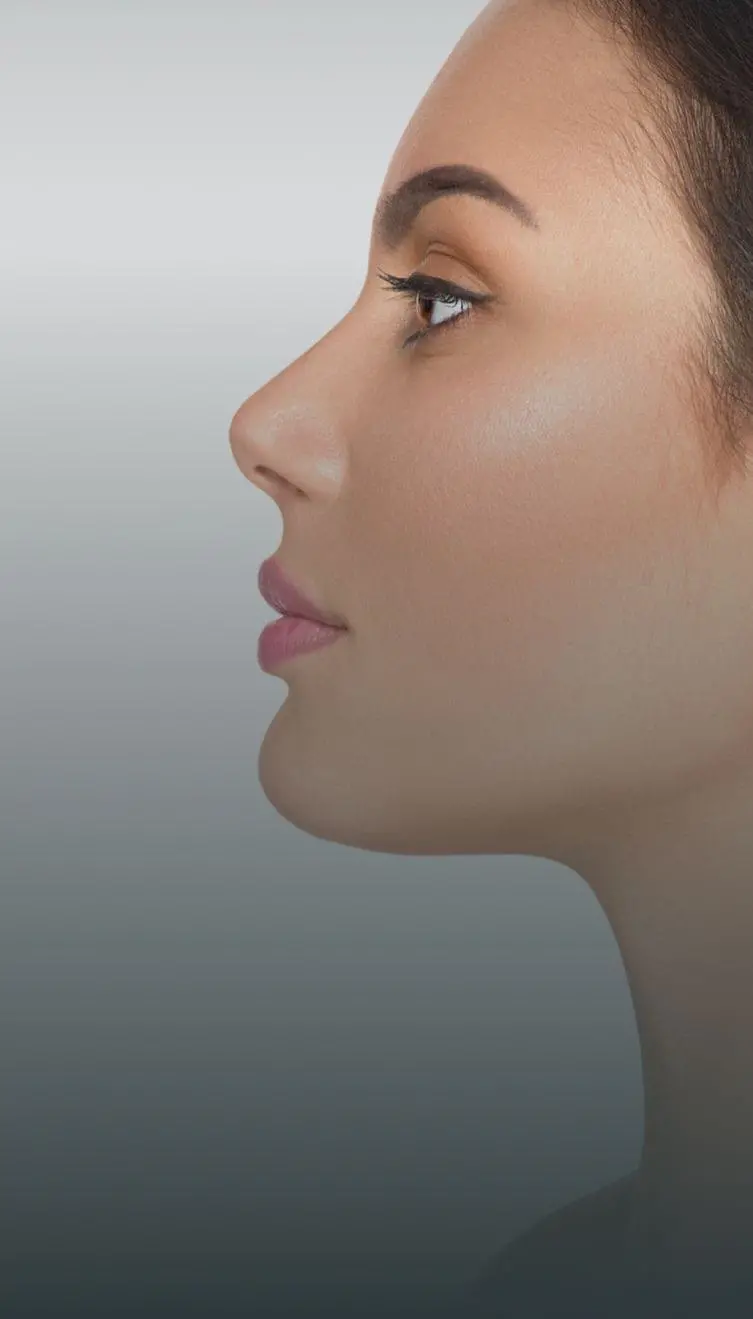
Rhinoplasty
Rhinoplasty is the surgical reshaping of the nose. It can be purely cosmetic (refining the dorsum, tip, alar base or projection), purely functional (correcting a deviated septum or collapsed valves) or, most often, both at once.
The procedure is performed under general anesthesia in an accredited private hospital and typically lasts between 2 and 4 hours depending on the complexity. Argaman Plastic Surgeries Mexico uses modern atraumatic instruments for bony work whenever osteotomies are required — this drastically reduces bruising, swelling and unintended fractures compared to traditional chisels.
Who is a good candidate?
Ideal candidates are adults in good general health, non-smokers (or able to stop 4 weeks before and 4 weeks after surgery), with realistic expectations and a fully developed facial skeleton (typically 17+ for women, 18+ for men). Skin quality, cartilage strength and any breathing concerns are evaluated during consultation. 3D imaging is used to simulate the projected outcome on your own face.
Expected results
The bony work is essentially permanent. Cosmetic refinements of the tip continue to evolve subtly for up to 12 months as residual swelling resolves. The bridge looks nearly final at 6 weeks; the tip needs 6 to 12 months. Once stable, the result is lifelong — rhinoplasty does not need to be redone, except in the rare case of revision.
Open vs Closed Approach
There are two main surgical approaches in modern rhinoplasty — both are performed at Argaman Plastic Surgeries Mexico, the choice depends on the complexity of the case and the surgeon's assessment during consultation.
1. Closed (endonasal) rhinoplasty
All incisions are made inside the nostrils — no external scar at all. Best suited for bridge work, hump reduction and mild tip refinement. Recovery is slightly faster.
2. Open (external) rhinoplasty
A tiny additional incision is made across the columella (the strip of skin between the nostrils). The skin is lifted, giving the surgeon direct visual access to the entire framework. Preferred for complex tip work, asymmetry correction, ethnic rhinoplasty and revisions. The columellar scar fades to near-invisibility within 6–12 months.
Preservation Rhinoplasty
Preservation rhinoplasty is the most recent evolution of nose surgery. Instead of removing the dorsal hump and rebuilding the bridge, the surgeon lowers the entire dorsum as a single block, preserving the natural ligaments and the dorsal aesthetic lines. The result is a more natural-looking bridge, less swelling and a faster recovery.
This technique is not suitable for every nose — it requires a hump that is mostly bony rather than cartilaginous, and a relatively straight underlying septum. Candidacy is assessed during consultation and confirmed with imaging.