15May
Let us advise you!
Contact us now. We advise you without obligation!

A smaller, more refined nose — without compromising your breathing or your natural facial harmony. Modern preservation rhinoplasty, structural grafting and conservative tip refinement, performed by one of the most experienced rhinoplasty teams in Mexico City.
The package includes:
All prices in US Dollars · personalised quotes are issued after your free consultation.
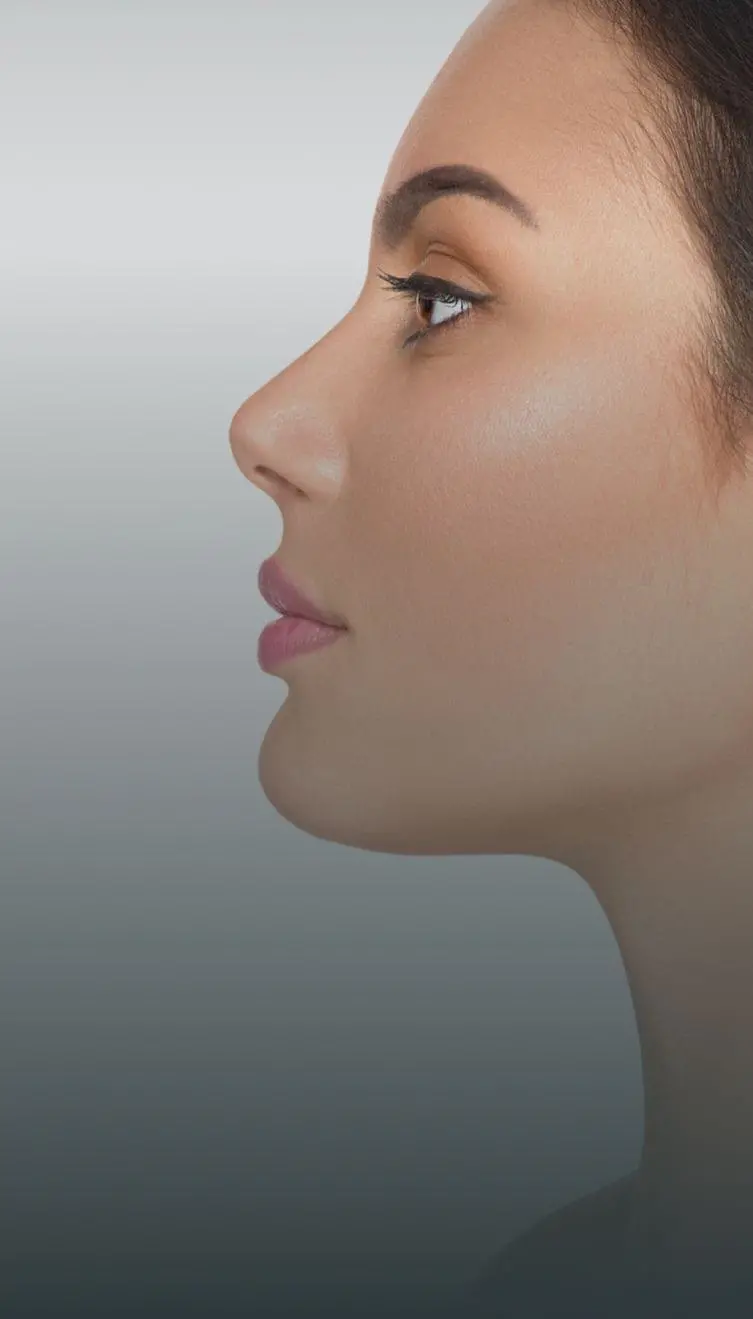
Nose reduction — in surgical terms reduction rhinoplasty — is the most requested rhinoplasty in the world. It addresses noses that feel too large, too long or too prominent for the face that carries them : a visible dorsal hump, a heavy or drooping tip, a wide bony base, an over-projected profile.
The aim is never to impose the same shape on every patient. It is a nose that belongs to your face — smaller and more refined, but unmistakably yours.
Ideal candidates are adults in good general health, non-smokers (or able to stop 4 weeks before and 4 weeks after surgery), with realistic expectations and a fully developed facial skeleton. Nose surgery is typically performed from 16 years for women and 18 years for men, once nasal growth has stabilised.
Skin quality, cartilage strength, projection and any breathing concerns are evaluated at consultation. 3D imaging is used to simulate the proposed reduction on your own face so the conversation is concrete.
The bony work is essentially permanent. The bridge looks nearly final at 6 weeks. The cartilaginous tip continues to refine subtly as residual swelling resolves — typically up to 12 months. Once stable, the result is lifelong and never needs to be redone.
Both approaches are performed at Argaman Plastic Surgeries Mexico — the choice depends on what your nose needs, not on a signature technique.
All incisions inside the nostrils — no external scar at all. Best suited for hump reduction, bridge refinement and mild tip work. Recovery is slightly faster.
A tiny additional incision across the columella gives the surgeon direct visual access to the framework. Preferred for complex tip work, asymmetric correction and structural grafting. The columellar scar fades to near invisibility within 6–12 months.
Modern nose reduction is far more conservative than the surgery of the 1980s. Instead of removing the dorsal hump and rebuilding the bridge, the surgeon lowers the entire dorsum as a single block, preserving the natural ligaments and the dorsal aesthetic lines.
The result is a more natural-looking bridge, less swelling and a faster recovery. Candidacy for true preservation rhinoplasty is confirmed at consultation with imaging.
The dorsal hump — that visible bump on the bridge — is the most frequent indication for nose reduction. Modern technique is conservative : we lower the hump precisely without over-reducing, using atraumatic instruments that produce clean, controlled bony work and minimal bruising.
When indicated, we use the preservation approach : the dorsum is lowered as one structural block rather than disassembled and rebuilt.
The nasal tip is the most technically demanding part of any reduction. Refinement is achieved with cartilage-sparing sutures (no resection of native tissue) and conservative re-shaping. We almost never cut cartilage away.
The goal at Argaman Plastic Surgeries Mexico is a natural, anatomically supported tip — never the over-rotated, pinched look of older techniques.
When the nostrils are wide — the so-called alar base — controlled narrowing refines the front view. The incisions are placed inside the nostril or precisely in the alar crease and are virtually invisible by 6–12 months. Wide-scar techniques from the 1980s are no longer used.
For a wide bony base, controlled lateral osteotomies narrow the nasal pyramid while preserving structural strength. The bony work is performed with atraumatic instruments for cleaner cuts, less bruising and a more predictable result.
Free online or in-person consultation with one of our board-certified surgeons. We review your medical history, evaluate the nasal pyramid, septum and tip support, take standardised photographs and use 3D imaging to simulate the proposed reduction on your own face. You receive a personalised plan and a transparent all-inclusive quote — with no obligation.
Pre-operative blood work and medical clearance are scheduled. You stop smoking 4 weeks before and avoid aspirin or anti-inflammatory medication for 10 days. Arrive in Mexico City 1 to 2 days before surgery — airport transfer and hotel check-in are handled by the Argaman Plastic Surgeries Mexico concierge.
You arrive fasting at the accredited private hospital. The anesthesiologist reviews your file and the surgeon marks the planned changes. The procedure lasts 2 to 4 hours under general anesthesia. You spend one night in hospital under monitoring before returning to the partner hotel with the external splint in place.
A licensed physician visits you daily at the hotel for the first 5–7 days. The external splint is removed at day 7 ; internal silicone splints (when used) at day 5–7. A final clinic check before flying home, then remote follow-up by video call continues for 12 months as the result refines.
Mild discomfort, well controlled with prescribed medication. The external splint is worn day and night. Bruising around the eyes peaks at day 2–3 then fades. Sleep on your back, head elevated. Avoid blowing the nose. External splint removal at day 7.
Most visible bruising resolves by day 14. Return to desk work after 10–14 days. The bridge already looks much like the final result — the tip is still slightly swollen. No glasses resting on the bridge for 6 weeks. No contact sport.
Light cardio is allowed at 3 weeks; full exercise at 6 weeks. Tip swelling continues to refine subtly. By month 3, the result is approximately 80% of final.
Final result visible at 12 months (longer for thick-skinned noses). Once stable, the result is permanent — nose reduction does not need to be redone. Annual remote check-ins are encouraged.
Nose reduction is one of the safest cosmetic procedures when performed by an experienced surgeon. Possible risks include bruising, swelling, mild bleeding (epistaxis), temporary numbness of the nasal tip and infection — all uncommon and well managed at Argaman Plastic Surgeries Mexico.
Over-aggressive reduction in older techniques could weaken the internal nasal valve and impair breathing. Modern preservation and structural rhinoplasty — the Argaman Plastic Surgeries Mexico standard — specifically guards against this by reinforcing the valve with cartilage grafts when needed. Most patients breathe as well or better after surgery.
About 5–15% of primary rhinoplasties worldwide need minor revision. At Argaman Plastic Surgeries Mexico the rate is below 5%. Most revisions are small adjustments performed under local anesthesia and are covered by our Surgical Guarantee within the warranty period.
All surgeons are board-certified (CMCPER, ASPS) with 20–30 years of experience. Procedures are performed exclusively in accredited private hospitals in Mexico City. We use modern atraumatic instruments for bony work, 3D simulation to align expectations and daily physician follow-up for the first week. Our complication rate is significantly below the international average.
The Argaman Plastic Surgeries Mexico nose reduction all-inclusive package starts at $3,600 USD and includes a septoplasty when functionally indicated, with no surcharge. Surgery alone is $3,100 USD when you organise your own accommodation. A reduction added to another procedure in the same session is also $3,100.
Surgery (cosmetic + functional when indicated), surgeon's fees, anesthesiologist, accredited private hospital stay, modern atraumatic instruments, 7-night hotel stay, all transfers (airport / hotel / hospital), bilingual assistant, all medications, external splint, daily physician home visits and 12 months of remote follow-up.
Mexico City offers 50–70% savings compared to the United States or Canada for the same level of expertise and facility quality. Most international nose reduction patients save $6,000 to $12,000 USD by choosing Argaman Plastic Surgeries Mexico.
Nose reduction — reduction rhinoplasty — is the rhinoplasty technique focused on decreasing the size or projection of the nose. It typically combines dorsal hump removal, tip refinement and narrowing of the bony pyramid, while preserving structural strength and breathing function.
Not in experienced hands. We use structural grafting (spreader grafts, alar batten grafts) to preserve the internal nasal valve — the area most often damaged by aggressive reduction in older techniques. Many patients actually breathe better after surgery because any associated septal deviation is corrected at the same time.
External splint for 7 days. Bruising fades by week 2 to 3. Return to office at 10 to 14 days. Full sport at 4 to 6 weeks. Most of the final result is visible at 3 months ; the tip continues to refine over 6 to 12 months.
The all-inclusive package starts at $3,600 USD and covers surgery, board-certified anesthesiologist, accredited private hospital, 7-night hotel stay, airport transfers, bilingual assistant and daily post-op visits. The equivalent in the United States runs $8,000 to $15,000 USD.
Likely yes if you have a dorsal hump, a long or wide nose, or a heavy tip that does not match your face, you are in good general health, you do not smoke (or accept to stop) and you have realistic expectations. Confirm during a free virtual consultation with one of our surgeons.
Neither is universally better — the right choice depends on what your nose needs. A simple hump reduction can usually be performed closed, with no visible scar. A complex tip rebuild often benefits from the direct visibility of an open approach (the tiny columellar scar fades to near invisibility within 6 to 12 months).
Yes. We provide a 3D facial simulation at the in-person consultation so you can see the proposed result before deciding to operate. The simulation is a guide, not a guarantee — biological healing introduces some variability — but it makes the conversation with your surgeon much more concrete.
The bridge looks nearly final at 6 weeks. The cartilaginous tip continues to refine subtly as residual swelling resolves — typically 12 months for cosmetic reduction. Once stable, the result is permanent.
World-class plastic surgery, coordinated from the heart of Mexico City — since 2012.
Calle Querétaro 58, Roma Nte
Mexico City, 06700